
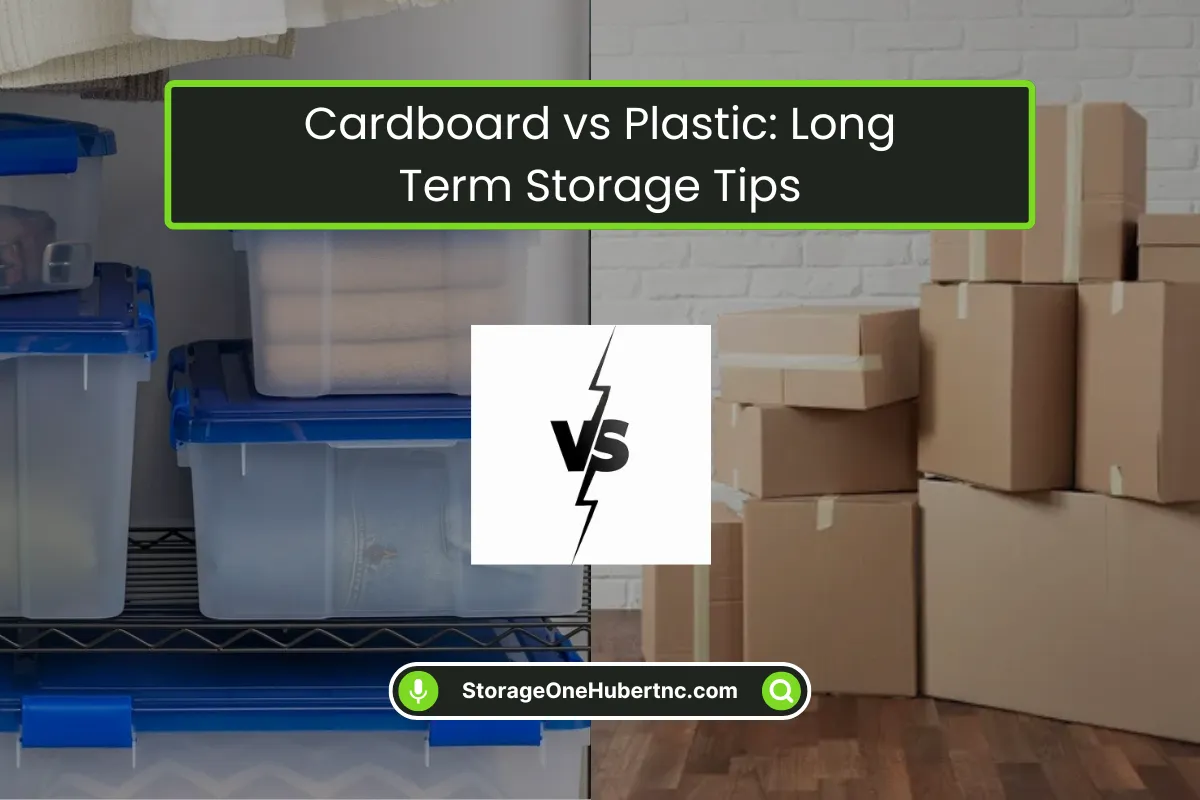
You know that moment when you open a box you packed five years ago, holding your breath? I had that moment last spring in my mom’s attic. I was looking for my old baseball cards. What I found instead was a lesson, soaked in mystery attic water and chewed by something I didn’t want to identify.
It’s a boring question, right? Cardboard or plastic? It seems so basic. But let me tell you, the wrong choice costs you money, memories, and a whole lot of frustration.
Here’s my take, after ruining some perfectly good stuff.
The Cardboard Trap
Look, we’ve all done it. You get a big delivery from Amazon. The box is sturdy! You think, “Perfect for the baby clothes.” It’s free, it’s right there, and it feels resourceful.
But here’s what cardboard is: a sponge. A tasty sponge.
It absorbs moisture from the air—even in a “dry” basement. Over months, it gets soft. The corners go first. Then the bottom starts to sag like a tired hammock. If there’s a tiny leak three feet away? The cardboard wicks it up like a straw.
And let’s talk about the critters. I’m not a bug expert, but I am an expert in finding their leftovers. Cardboard is like a five-star restaurant and hotel for insects and mice. They eat the glue. They nibble the paper to make nests. My “perfect” box of tax documents from 2012 had a lovely, confetti-like edge courtesy of a silverfish family.
The worst part? The collapse. You build a beautiful, Tetris-like wall of boxes. It looks solid. Then, one humid Tuesday in July, the whole thing just… slumps. It’s a quiet, cardboard avalanche. Now your “Fragile – China” box is supporting the full weight of “Old College Textbooks.”
Why I Switched to Plastic (And What I Got Wrong)
After the Great Attic Disaster, I swore off cardboard for anything I cared about. I went to the big box store and bought a stack of those shiny plastic bins. Felt like a grown-up.
- First win: stacking. They lock together. You can go five high and they don’t flinch. The bottom bin isn’t slowly having a panic attack.
- Second win: the seal. A good lid snaps on. It keeps out dust, that weird attic smell, and most of the moisture. It’s not a submarine hatch, but it’s a huge barrier.
- Third win: cleaning. A dusty plastic bin wipes off. A dusty cardboard box is just permanently sad.
But I made a classic rookie mistake. I washed some camping gear, threw it in a bin while it was still a little damp, and sealed it shut. I created a mini tropical rainforest in there. Opened it eight months later to a science experiment of mold. So the rule is absolute: Only store things that are completely, totally, bone-dry.
Another thing—don’t buy the clear ones if you’re storing photos or fabrics. Light fades things. Get the opaque colored ones.
My Simple, No-BS Guide
Forget the fancy charts. Here’s my kitchen-table logic:
- If you love it, use plastic. Your wedding dress, your kid’s first drawings, your vintage vinyl. Plastic.
- If it’s fabric, use plastic. Clothes, blankets, curtains. Moths can’t chew through plastic.
- If it goes ANYWHERE but a living space (garage, attic, shed, basement), use plastic. The environment is too harsh.
- Cardboard is for “maybe” items. The books you might donate next year. The extra set of dishes you’re cycling out. The packaging for the TV you’re keeping. Use it short-term, indoors, for stuff that won’t make you cry if it gets a dent.
And for the love of all that is holy, LABEL THE SIDES, NOT THE TOP. You can’t read the top when they’re stacked. Use a fat black marker. “KITCHEN – POTS / ROLLING PIN.” “HANNAH’S CLOTHES – 3-6 MONTHS.” Be a librarian for your own life.
The Game-Changer No One Talks About
Here’s the secret no one tells you when you buy those bins: where you put them matters just as much.
A plastic bin is a soldier, but you don’t send a soldier into battle alone. You give them backup. Stashing your fortress of bins in a dripping-wet, 120-degree attic is asking for trouble. The plastic gets brittle in the cold, the seals work harder, and over years, extreme heat can still warp things inside.
This is the exact reason I became a believer in professional storage. And I’m not just saying this because it’s my business—I’m saying it because I needed it. At Storage One Hubert, we don’t just rent you an empty room. We offer clean, climate-controlled units because I know what’s at stake. It’s not junk. It’s your life in boxes. Climate control means steady temperature and humidity year-round. It’s the best friend your plastic bins could ever have. It’s the ultimate backup, so when you open that bin in five years, it’s not a gamble—it’s a reunion.
So, save the cardboard for recycling day. Spend the $15 on a good bin. Label it like your sanity depends on it. And give it a good home. Your future self, the one opening that box on a random Tuesday years from now, will look at that perfectly preserved photo or that soft, moth-free sweater, and think, “Thank you, past me. You got it right.”







0 Comments