
Hey there,
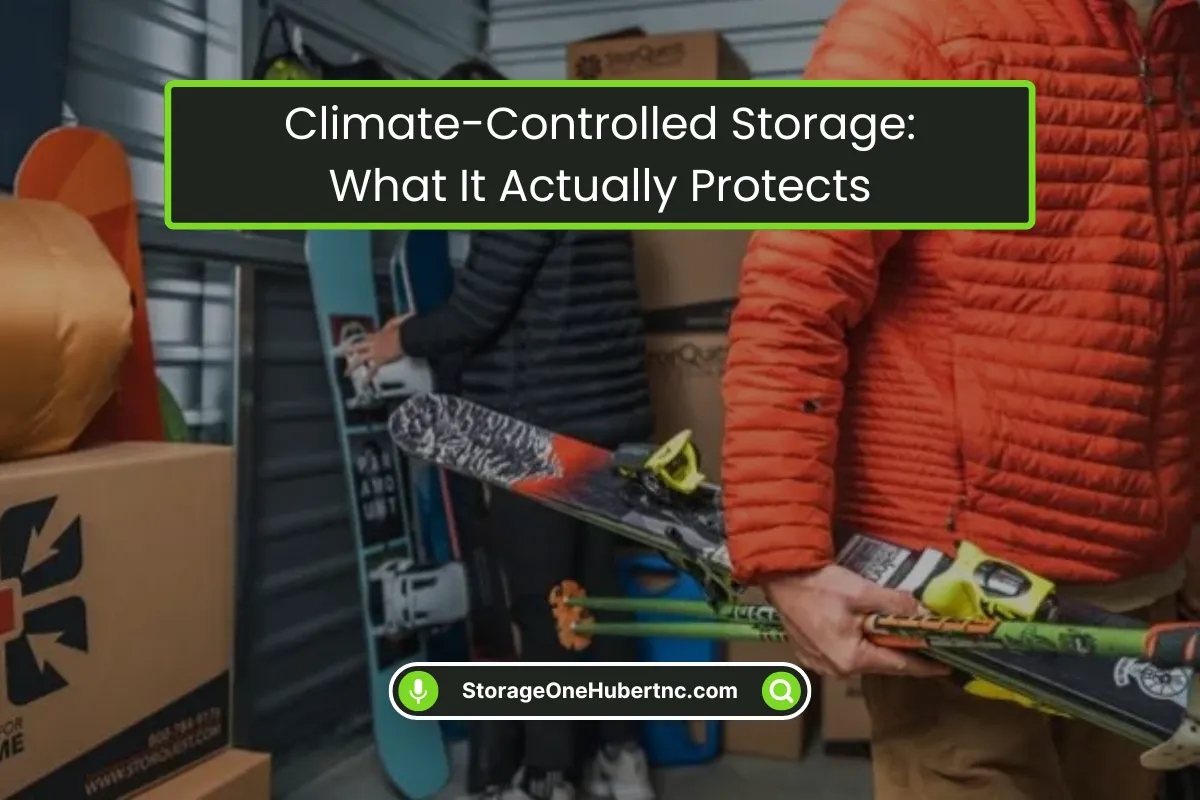
So, you’ve got some gear to store. Maybe it’s the dining room set you inherited that doesn’t fit in the new place. Maybe it’s your kid’s college stuff for the summer, or your entire inventory for your online vintage t-shirt shop. You’re Googling storage units, seeing prices, and wondering if you really need the fancy “climate-controlled” one.
I’m going to be straight with you: for a lot of things, you absolutely do.
I’m not just saying that because we offer them at Storage One Hubert. I’m saying it because I’ve seen the other side of it. I’ve had folks come in, heartbroken, because they saved a few bucks a month on a standard unit, only to find their priceless family photos stuck together in a mildewy mess. Or a gorgeous wooden chair leg that’s now warped beyond repair.
It stinks. And I hate seeing it.
So let’s have a real, human conversation about what that “climate control” button on our website actually means for your stuff.
It’s Not Just “Not Hot.” It’s “Not Humid.”
This is the biggest thing people miss. We think about summer heat, right? A baking-hot metal unit feels awful, so we get that air conditioning is good.
But the real villain, the silent destroyer, is humidity. That thick, muggy moisture in the air.
Here’s what humidity does on a stealth mission:
- It sneaks into wood, makes it swell, and then when it dries, it cracks. Your heirloom dresser? Now it has a split down the middle.
- It settles on metal as condensation. Inside your old amplifier or that nice mountain bike frame? Hello, rust.
- It gets into paper, fabric, leather. And then… mold. Musty, smelly, often permanent mold. That box of your mom’s letters? That leather jacket? Ruined.
A climate-controlled unit at our place isn’t just an AC unit kicking on when it’s hot. It’s a sealed environment. We keep the temperature steady (think a cool 70-ish, not freezing, not roasting) and we use equipment to actively pull moisture out of the air. We keep that humidity in a sweet spot where your stuff just… chills. Literally.
Let’s Play “Should I Climate Control It?”
Okay, practical time. Look at what you’re storing. Is it:
- Made of wood? (Furniture, instruments, picture frames) → YES.
- Made of fabric or leather? (Clothes, couches, handbags, wedding dresses) → YES.
- Electronics or appliances? (TVs, fridges, records, vintage gaming consoles) → YES.
- Paper or important to you? (Books, documents, photo albums, stamp collections, your kid’s art) → YES.
- Valuables you can’t replace? (Anything sentimental, antiques, wine) → A thousand times, YES.
If you’re just storing garden tools, tires, or plastic bins of holiday decorations? A standard unit is probably fine. Save the money.
But if you’re storing things that have a heartbeat—things you’d be upset about losing—the math changes. Paying an extra $20 or $30 a month is cheap insurance against a total loss.
The Other Sneaky Benefit Nobody Talks About
Here’s a bonus: our climate-controlled units are inside our main building. They’re not facing an outside wall where the sun beats down all afternoon. They’re down a hallway, behind another door.
What does that mean for you?
- It’s cleaner. Less dust, fewer bugs, no pollen drifting in under a roll-up door.
- It feels more secure. It just does. You’re not loading your grandma’s china in a parking lot in the rain.
- The temperature is truly consistent. No wild swings from day to night.
You’re not just renting a metal closet. You’re renting a room for your things.
How We Do It (And How You Can Help)
We take this seriously at Storage One Hubert. Our systems are monitored, and we check on them constantly. It’s not a “set it and forget it” thing for us. We know what’s in your unit matters.
You can help, too:
- Don’t use cardboard boxes if you can help it. They suck up moisture and attract silverfish (tiny, gross bugs). Grab some of those plastic bins with the yellow lids from the hardware store. They’re awesome.
- Leave a little space. Don’t shove everything wall-to-wall. Let the air from our system flow around your stuff.
- Clean it first. Please, for the love of all that is good, don’t store a damp tent or muddy shoes. You’re bringing the humidity in with you!
The Bottom Line
At the end of the day, you’re not storing things. You’re storing pieces of your life. The table where you ate family dinners. The records that got you through college. The inventory that funds your dream.
Protecting that isn’t an upsell. It’s our job.
If you’re still on the fence, come on down. Seriously. I’ll show you the difference between the units. You can feel the air. You’ll get it immediately. Then you can decide what’s right for you, with no pressure.
Because the goal isn’t to rent you the most expensive unit. The goal is to make sure that when you open that door again in six months or five years, everything inside is exactly as you left it.
That’s the peace of mind we’re really selling.
Give us a shout or stop by if you want to talk more.







0 Comments