
Look, I’m just a guy who lost three years of photos because I left a hard drive on a bookshelf. It was tucked next to a plant I forgot to water. The plant died, and so did the drive. Not from a spill or a drop. From dust. From the slow, dry heat of a sunbeam that hit it for two hours every afternoon. I didn’t think about that. Who does?
You probably have a backup drive. Maybe you even have two. But where are they? In a drawer? On a shelf in your garage? In a cardboard box marked “IMPORTANT” that’s now warped from the basement damp? You’re nodding. I know you are. Because we all do it. We buy the thing, we do the backup, and then we shove it somewhere and call it a day. We think we’ve done the responsible thing.
We haven’t. We’ve created a time bomb.
Let me tell you what I learned the hard way. That drive isn’t just data. It’s a physical object. It has parts that expand and contract. It has circuit boards that can corrode. It has a motor that can seize. And your house—my house, any normal house—is a terrible place for it to just… sit.
Think about where you put it
- The attic? Come on. It’s 100 degrees up there in the summer. You’re slow-cooking your family videos.
- The basement? Feel that cool dampness? That’s the smell of your wedding photos rusting from the inside out.
- A closet? Seems safe, until your kid kicks a soccer ball against the door, the shelf vibrates, and the drive falls two feet onto a carpet. That’s all it takes.
My wake-up call was that dead drive. The recovery guy charged me $400 and handed me a disc with half my pictures corrupted into gray squares. “Heat damage,” he said, shrugging. “And maybe a little moisture. They don’t like being stored, you know?”
I wanted to yell, “THEN WHERE AM I SUPPOSED TO PUT THEM?!”
After I got over being mad, I got practical. Here’s what I do now. It’s not complicated, but it works.
First, the digital goodbye
Before I store any drive, I plug it in one last time. I don’t just look at the folder names. I open a few random files. I make sure the “2021 Vacation” folder has photos of the beach, not just a scanned copy of my car’s manual. Then, I make sure the absolute can’t-lose stuff is also somewhere else—on my computer, in the cloud, on a different drive I keep in my desk. Never trust one copy.
Second, I put it to bed
I don’t use the original box. That thin cardboard is useless. I use a plastic bin. A solid one with a lid that clicks. Inside, I wrap the drive in a soft cloth—an old t-shirt, a microfiber rag. No scratching, no bumping. If I’m storing a laptop, I take the battery out. Always. A $10 battery can ruin a $1000 laptop if it leaks. I throw a couple of those “do not eat” silica gel packets in the bin to keep things dry.
Third, I label it like my sanity depends on it. I write directly on the bin with a fat black marker. “PHOTOS 2018-2020. LAST CHECKED NOV 2023.” Not a sticky note. A permanent declaration.
But here was my real problem: Where do I put the bin?
My house doesn’t have a magic room that’s always 68 degrees and dry. My garage freezes. My attic roasts. My office closet is a disaster zone.
I needed a place that was not my house but still mine. I needed a boring room.
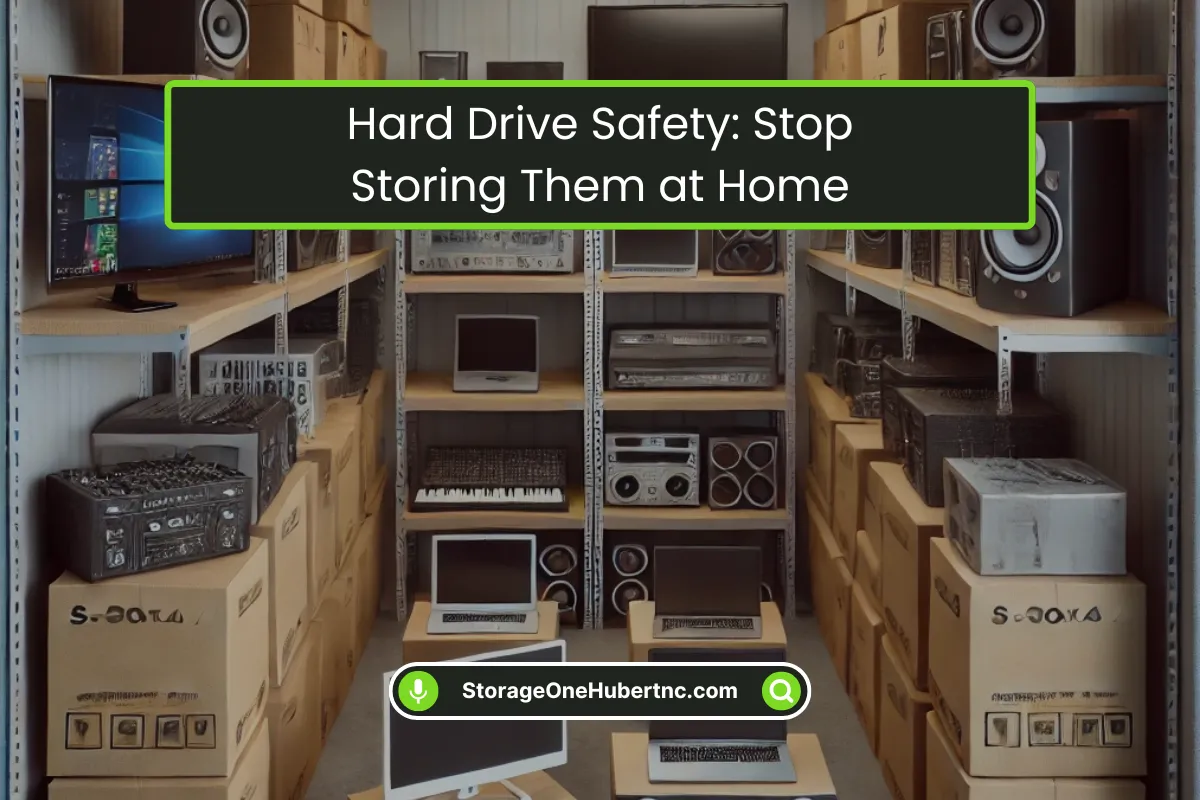
So, I did something that felt both extreme and obvious: I rented a very small storage unit. But I didn’t just get any unit. I specifically asked for a climate-controlled unit at Storage One Hubert. The guy on the phone knew exactly what I meant. “For electronics?” he asked. “Yep,” I said. He told me they get that a lot.
Now, my plastic bin lives on a metal shelf in a clean, white room that never gets hot, never gets damp, and never has a soccer ball kicked near it. It is profoundly, wonderfully boring in there. When I needed my old tax documents last April, I drove five minutes, grabbed the bin, and had them in ten. It’s not a hassle. It’s a relief.
It’s my insurance policy. The final, physical piece of the backup puzzle that every tech article talks about but never explains practically: the off-site copy.
Doing this didn’t feel like organizing. It felt like fixing a mistake I’d been making for a decade. That quiet worry in the back of my mind—where are my photos, are they okay—just vanished.
Your backup drive deserves better than a drawer. Your memories deserve a real home. Not a dusty shelf, but a safe place. Sometimes, the safest place for something precious is just… somewhere else.







0 Comments